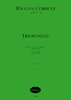
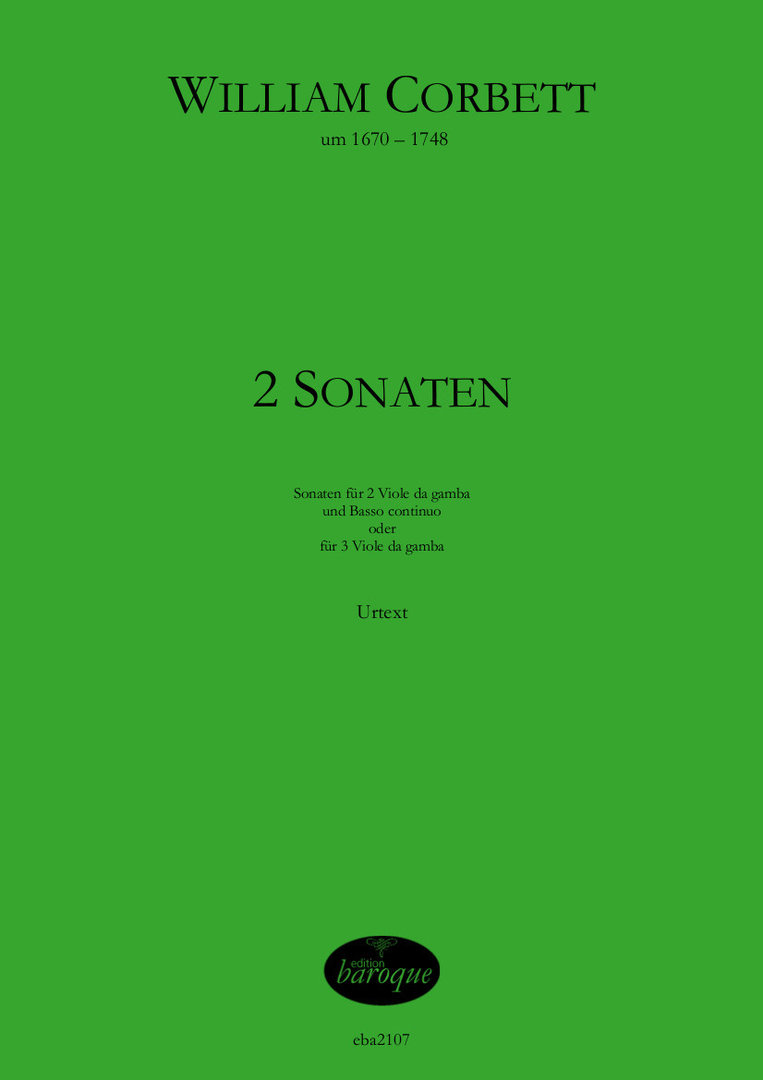
Corbett, William (1670 – 1748): Sonate 1 & 2 for two Viole da gamba and Bc - UT, eba2107

Product no.: 2107
14.90

Price incl. VAT, plus delivery


G major and D major after the sonatas 1-2 from op. 2.
Anonymous arrangement from the Rostock library for 2 viole da gamba and basso continuo in the Urtext edition without realisation for a keyboard instrument.

Two beautiful sonatas that can also be played with three viols da gamba without continuo instrument
(SSB or BBB).

___________________________________

William Corbett was probably born around 1670 in London, where he died on 7 March 1748. He was concertmaster and composer at Lincoln's Inn Fields Theatre in London from 1700 to 1703 and from 1705 at the Queen's Theatre in the Haymarket, where he was appointed director of the orchestra shortly afterwards. He stayed in Rome from 1711 to 1713 and travelled to Italy several times during this time as a member of the Royal Band of Music (1716-1747).

In addition to his activities as a violin virtuoso, he was also an outstanding composer. He composed numerous stage works and wrote several volumes of trio sonatas.

The Rostock University Library holds two sonatas in a copy of parts by an anonymous scribe under the shelfmark Musica Saec. XVIII. 6637 in the Friedrich Ludwig Collection, which goes back to the Hereditary Prince Friedrich Ludwig of Württemberg-Stuttgart (1698-1731). The heading in the bass book reads:

Sonata 1.ma Basso. Corbet

This is the part transcription and transposition (a fourth lower) for two viole da gamba of the first two sonatas of a collection that has survived in two sources:

VIII SONATES
VI de Mr. Corbett à 2 Flutes & une Basse
& II DE MR. FINGER
un à 2 Flutes & une Basse & l'autre
à une Flùte, Hautboy ou Violin & une Basse
Chez Estienne Roger Marchand Libraire
Amsterdam 1701

and

Six sonatas
consisting of Preludes, Allemands, Corants, Sarabands and Jiggs op. 2
London (1705)

For comparison, I have used the print "Amsterdam 1701", which is in the Marien-Gymnasium Jever (hereafter referred to as "Jever"). The anonymous arranger added a few chords to the final cadences. The last movement "Gavotta Presto" is missing in the Rostock manuscript; I have added it from "Jever". A figuring is missing in the basso continuo part; it was also added from this source.

The original clef of the two upper parts is French treble clef with a few "excursions" into bass clef, which once again makes the scoring unclear, as with many pieces in this collection. If the French treble clef is used, the sonatas are for soprano viols (the bass clef is then only the reading of the French treble clef octavated downwards). treble clef). If, on the other hand, the bass clef parts are taken into account and the treble clef is regarded as bass clef transposed up an octave, then these are sonatas for 2 bass viols.

The origin of the pieces (originally for recorders; see the editions (eb 1223-1225)) would speak in favour of scoring with soprano instruments, as would the fact that in the second sonata the second voice goes below the bass in some places, resulting in unsightly fourth sexte chords.

Individual parts for both instrumentations are included so that you can form your own judgement.

In the case of an instrumentation with bass viols, it is advisable to read the small print for each part.

Translated with www.DeepL.com/Translator (free version)

Additional product information

Beispielseiten Download

Customers who bought this product also bought
*
Prices incl. VAT, plus delivery

Browse these categories as well: Streichinstrumente, Viola da gamba